

At MitonOptimal we take asset allocation (AA) very seriously, taking into consideration both Strategic AA (3-7 years) and Tactical AA within the various asset classes. This quarterly piece provides insight into our short term tactical calls on a 12-month view (reviewed quarterly) and as such may diverge from our long term strategic AA views. We review our strategic AA bi-annually as we believe this is prudent practice, in a world dominated by debt de-leveraging, central bank and political interference.
|
Index |
Q3-2024 |
Q2-2024 |
|
FTSE/JSE All Share |
15.91 |
8.19 |
|
FTSE/JSE SA Listed Property |
30.04 |
5.50 |
|
FTSE/JSE All Bond |
16.68 |
7.49 |
|
FTSE/JSE ALB 1-3 Yr |
8.08 |
3.35 |
|
Allan Gray Money Market |
6.73 |
2.19 |
|
STeFI Composite |
6.33 |
2.02 |
|
MSCI World |
12.00 |
-1.03 |
|
MSCI EM |
10.12 |
1.25 |
|
S&P 500 |
14.68 |
0.46 |
|
S&P Global REIT |
7.35 |
-4.71 |
|
GinsGlobal Global Bond Index |
-4.38 |
-5.88 |
|
Bloomberg Commodity |
-0.25 |
-0.79 |
|
USD Money Market |
-1.91 |
-3.57 |
Source: Morningstar in ZAR
SA EQUITY
OVERWEIGHT – OUTPERFORMED
The third quarter of 2024 was a pivotal period for South African equities, driven by a confluence of political stability, improving macroeconomic conditions, and strong market sentiment. A key factor contributing to this positive market environment was the formation of the Government of National Unity (GNU) in mid-2024, which helped restore investor and business confidence after a period of political uncertainty and declining sentiment earlier in the year.
The creation of the GNU played a significant role in stabilizing the political landscape, which had been a source of concern for investors. This newfound political stability was complemented by a marked improvement in energy supply, with the country experiencing over 150 consecutive days without loadshedding. This boost in confidence translated into a strong rally in the local equity markets. Investors became more willing to take on risk in an environment where political uncertainty had been reduced, and there was growing optimism about the country’s economic trajectory. This political cohesion and macroeconomic stability also gave investors’ confidence that the South African Reserve Bank (SARB) would potentially cut interest rates later in the year, a prospect that further fueled market enthusiasm.
Financial stocks, which are highly sensitive to political and economic stability, posted an impressive return of 13.89% during Q3 2024. The possibility of lower interest rates, alongside the easing of inflation, particularly supported this sector. The stabilization of the political environment led to renewed optimism about growth prospects for South Africa’s banking and financial services industries.
Industrials, another key sector, delivered an 11.46% quarterly return. Much of this performance was driven by large-cap stocks such as Naspers and Prosus, which have significant exposure to global technology markets. Investors favored these companies as a hedge against local risks, while still benefiting from their listings on the JSE. Resource stocks faced a more turbulent quarter, with some volatility driven by weaker-than-expected results from major mining companies in August, the sector ended in the red with a quarterly return of -1.10%.
One of the most critical macroeconomic developments during Q3 2024 was the sustained decline in inflation, which fell to 4.4% (yoy) by the end of August. This marked a significant reduction from previous levels, and it played a crucial role in shaping the SARBs decision to cut rates by 25bps in September.
Our funds and model portfolios were overweight in South African equities during this period, benefitting greatly from these favorable conditions. Our clients benefitted from the alignment between our strategic positioning and the positive developments in the local market.
SA LISTED PROPERTY
OVERWEIGHT – OUTPERFORMED
The South African FTSE/JSE All Property Index posted a quarterly gain of 18.7% during Q3 2024, outperforming all other asset classes (discussed in this report) over the period. This robust performance was largely attributed to the sharp decline in inflation, which fell to 4.4% by the end of August, reinforcing the South African Reserve Bank’s (SARB) decision to cut interest rates by 25bps.
Business confidence also saw a significant recovery during the quarter, driven by improved political stability and more reliable power supply. Over 150 consecutive days without loadshedding helped support economic activity, particularly in sectors reliant on a stable energy supply, such as commercial property. This improved sentiment led to renewed interest in the property sector as a stable income-generating asset class.
Our strategic decision to overweight the South African listed property sector proved to be highly advantageous for our clients during the third quarter of 2024. Our overweight positioning in listed property was driven by the recognition that the sector would benefit significantly from falling inflation, declining interest rates, and a more favourable political environment. We maintained a focus on high-quality, income-generating property stocks that were well-positioned to benefit from a stabilizing economic backdrop. This approach enabled our clients to benefit from both capital appreciation and solid income yields, which were enhanced by improving rental income.
SA FIXED INTEREST
UNDERWEIGHT – NEUTRAL PERFORMANCE
Like SA equity and SA Property, Bonds benefitted from foreign inflows and a more optimistic view of our politics. We saw yields coming down across the curve, but especially in the more liquid bonds. This, together with a strengthening ZAR and the SARB cutting rates, meant that the ALBI (10.54%) was one of the best asset classes for the quarter, second only to SA equities and outperforming SA property.
Our neutral allocation to fixed interest meant that the outperformance had a muted effect on relative returns for the portfolios. We are still neutral going into Q4 with a preference for risk assets over fixed interest, but not going underweight as a cut in interest rates would benefit bonds in the short term.
SA CASH
UNDERWEIGHT – NEUTRAL PERFORMANCE
We remained underweight SA Cash for the entire quarter, seeing more opportunity to deploy into risk assets, especially South African equities and listed property. The STeFI Composite Index returned 2.07% in a quarter where risk assets did well, and bond yields came down. ZAR strength meant that it outperformed global assets but was still trumped by good returns from risk assets and bonds. We keep the view to be underweight cash in Q4 2024, as we see too many other opportunities to ignore.
GLOBAL EQUITIES
UNDERWEIGHT – NEUTRAL PERFORMANCE
Our portfolios were underweight in developed markets for most of Q3. Although global equities (in general) showed strong performance in USD terms, with the MSCI World returning 6.36% and the ACWI 6.61%, when converted to ZAR, these returns were notably lower at 0.38% and 0.61%, respectively. This gap highlights the impact of a strengthening Rand against the US Dollar during the quarter, which eroded much of the gains that South African investors could have reaped from their developed market exposures.
Emerging markets were a major driver of positive performance for South African investors. With a neutral positioning in portfolios, the MSCI Emerging Markets (EM) Index delivered an 8.72% return in USD, translating to 2.60% in ZAR. China’s aggressive fiscal and monetary stimulus, aimed at bolstering its slowing economy, played a significant role in the rally, alongside positive developments in South Africa and India.
South Africa itself benefitted from political stability, especially following the formation of the Government of National Unity (GNU), and the South African Reserve Bank’s decision to cut interest rates in line with global trends. This contributed to favourable market conditions, helping support local equities and enhancing the country’s standing within the broader emerging market index. South Africa’s equity market showed resilience, reflecting the broader trend of outperformance within emerging markets.
Central Bank actions were pivotal in shaping global equity market performance during the quarter. The US Federal Reserve implemented a 50 basispoint rate cut in mid-September, lowering the target range to 4.75%-5.00%. This move, along with similar actions from the Bank of England (BoE) and the European Central Bank (ECB), helped propel equity markets, especially in developed regions. However, the USD weakened because of these policies, which diminished the returns for South African investors holding assets in US Dollars.
The BoE and ECB similarly cut interest rates, with the BoE reducing rates to 5% and the ECB lowering its deposit rate to 3.5%. This accommodative monetary stance contributed to the recovery of European and UK equity markets, but the currency conversion into ZAR lessened the benefits for South African investors.
Meanwhile, emerging markets, particularly China, saw the implementation of stimulus packages to revitalize slowing economic growth. These measures, combined with improved economic data from other emerging markets like South Africa, India, and Brazil, helped boost the MSCI EM Index’s performance. China’s 8.72% USD return was particularly strong, fuelled by government spending, rate cuts, and fiscal measures designed to spur investment.
GLOBAL PROPERTY
UNDERWEIGHT – NEUTRAL PERFORMANCE
Global property was the one sector where we had relative underperformance because of our underweight allocation. The global dovish sentiment from Central Banks has buoyed listed property prices and attracted renewed interest in the asset class. Our view is that this might have pushed the asset class into over-priced territory with fundamentals not being in favour for much longer.
Within the property that we hold, our sector allocations are still constant. We are focused on sectors such as warehousing, storage, data centers and infrastructure. We could be adding more to property if we feel an overweight allocation is warranted and prices revert to the longer-term average.
GLOBAL FIXED INTEREST
UNDERWEIGHT – UNDERPERFORMED
In the US, the bond market experienced significant movement when the Federal Reserve made its first interest rate cut in four years during its September meeting. This larger-than-expected 50 basis points (bps) cut was driven by a combination of factors, including falling inflation and a softening labour market, which indicated slower economic momentum. Previously, investors had expected more aggressive rate hikes to continue, but this shift led to a sharp drop in US Treasury yields, with bond prices rallying as expectations of further cuts grew. The decline in inflation to more manageable levels provided the Fed with the confidence to adopt a more dovish stance, easing the pressure on bond markets.
In Europe, the European Central Bank (ECB) also cut its interest rates by 25bps in September, marking its second rate cut of the year. The ECB’s decision reflected growing confidence that inflation was under control, as Eurozone inflation cooled to 2.2%, the lowest level since mid-2021. This prompted a fall in yields across European bonds, as investors grew more optimistic about future monetary easing. However, the broader economic outlook in Europe remains clouded by weak growth, with countries like Germany slipping into recession during the third quarter, limiting the potential for strong bond market performance
In the UK, inflation also cooled to 2.2% by July and August, allowing the Bank of England (BoE) to cut rates by 25bps in August. Despite this, the BoE kept rates unchanged at 5% in September, as inflation remained above the BoE’s target, and monetary policy remained highly restrictive. As a result, the fall in Gilt yields was less pronounced than in other major markets.
Despite the rate cuts and falling yields across several major bond markets, the portfolio has maintained its underweight position in global bonds. This decision is driven by the expectation that even with recent monetary easing, bond returns remain relatively unattractive compared to higher-yielding asset classes such as equities and real estate. Although inflation has moderated in key regions, the potential for renewed inflationary pressures or unexpected policy shifts remains a risk, which could lead to volatility in bond markets.
GLOBAL CASH
UNDERWEIGHT – UNDERPERFORMED
As with local cash exposure, the global cash allocation is used as either a risk mitigator or as a place holder for future deployment into risk opportunities. We remained underweight during Q3 as risk assets provided us with opportunities to use the cash at hand. This proved a good call as risk assets outperformed global cash during the period.
We continue to see opportunities in risk assets globally and in South African assets, so we are sticking to our underweight exposure for now. There are, however, still some risks that we fear could play out over the medium term and we are therefore cautious about adding too much to risk assets just yet.
- Overweight / Neutral / Underweight indicates the MitonOptimal asset allocation views
- Outperformed / Neutral / Underperformed indicates the asset class performance over the quarter
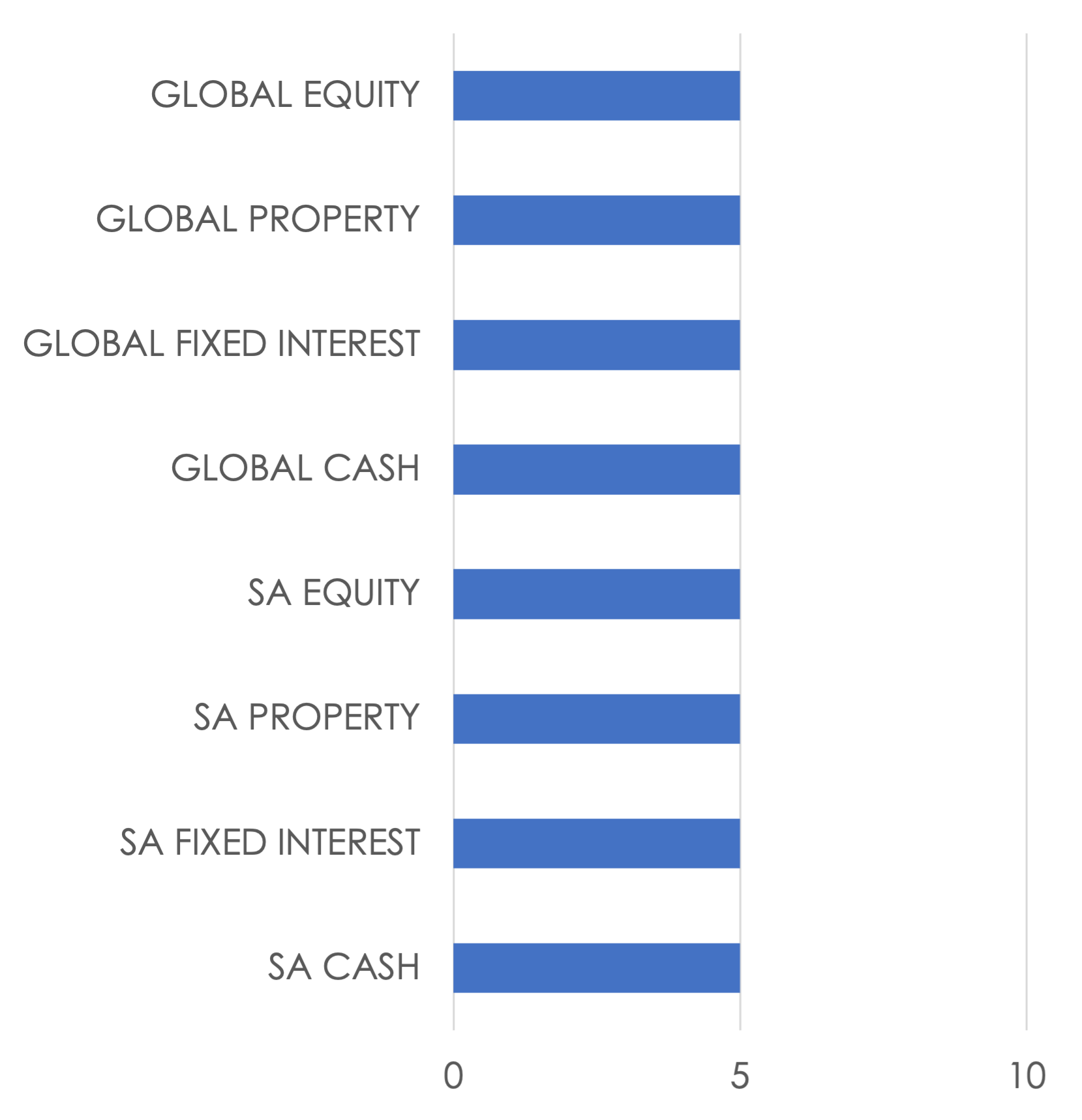
All data sourced from Morningstar
DOWNLOAD: QUARTERLY MARKET INSIGHTS: Q3 2024

Jacques de Kock
Quantitative Analyst & Portfolio Manager
The content of this article is for information purposes only and does not constitute an offer or invitation to any person. The opinions expressed are subject to change and are not to be interpreted as investment advice. You should consult an adviser who will be able to provide appropriate advice that is based on your specific needs and circumstances. The information and opinions contained herein have been compiled or arrived at from sources believed to be reliable and given in good faith, but no representation is made as to their accuracy, completeness or correctness. MitonOptimal South Africa (Pty) Limited is an Authorised Financial Services Provider Licence No. 28160, regulated by the Financial Sector Conduct Authority (FSCA) – Registration No. 2005/032750/07.MitonOptimal Portfolio Management (Pty) Limited is an Authorised Financial Services Provider Licence No. 734, regulated by the FSCA – Registration No. 2000/000717/07.